How to Train Dog Leash Reactivity on Walks
(This ENDED his barking & lunging after 1 session)
By Jenna Romano
I recently worked with a guardian and her reactive foster dog, Scope, who screamed “like a banshee” at other dogs on walks.
Scope lives in a high-density apartment environment with constant dog triggers, no “off-peak hours,” nowhere to hide from other dogs
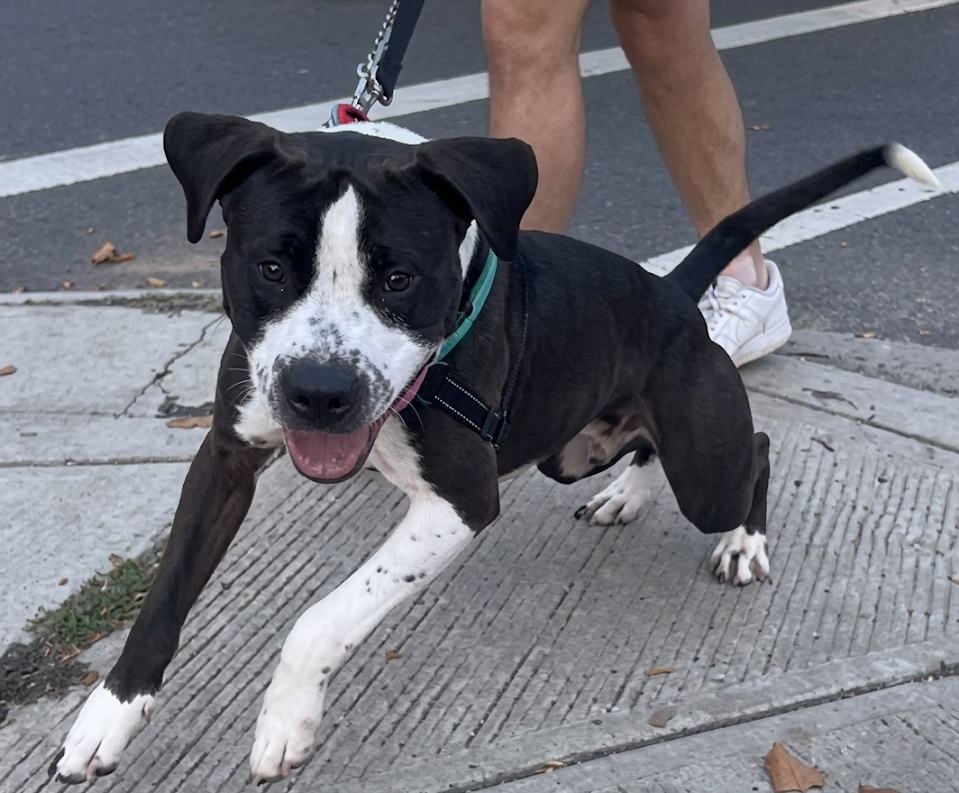
From day one, Scope was:
Barking at other dogs
Lunging and tugging on his leash to inch closer to dogs
Always searching for people who look like they might have dogs with them
The kind of behavior that made Scope’s guardian wonder:
Is it aggression?
Fear?
Frustration?
Am I making Scope worse somehow?
Well, Scope was telling us exactly what he was feeling.
Not through his “bad behavior.” But through his voice.
In videos of his reactivity, we heard
high-pitched, frantic squealing vocalizations → “hey, hey, hey, over there!!”
deeper, compressed, gurgling → pressure building, frustration intensifying
After time decoding those vocalizations, we realized Scope’s leash reactivity wasn’t like, “I hate that dog. Make it go away.”
It was, “I see that dog and I don’t understand why I can’t go interact with him normally. Why am I confined to this leash? This is not normal.”
How to Train Dog Leash Reactivity on Walks
There are two different layers to this work. (Most people collapse them into one, and that’s where progress stalls.)
LAYER #1: COPING MECHANISMS
You need a way to get your dog out of situations they can’t handle. In other words, you need to train the “Flight” in Fight/Flight/Freeze. With my clients in the Recovering Rover Program, we call this trained flight behavior “let’s get outta here.”
Now, don’t get it twisted - the flight behavior is not “fixing” your dog’s reactivity (despite what some gurus on the internet may lead you to believe.)
Actually, the point is to give your dog a better outlet for his stress than barking, lunging, tugging, and otherwise actin’ a fool.
[Watch the vid linked below this article for a tutorial on how to train “Let’s Get Outta Here” (with real dog demos)]
LAYER #2: ACTUALLY CHANGE THE EMOTIONAL RESPONSE TO THE TRIGGER
This is where real, sustainable behavior change happens.
❌Not through always avoiding the triggers (“management”) and not through “Dominating” your dog.
✅We do this through treating your dog’s internal (emotional and physiological) state. The big, fancy term for this strategy is “Counter-Conditioning.”
On a high level, Counter-Conditioning is Classical Conditioning (whaddup, Pavlov) and Operant Conditioning coming together to desensitize your dog to his trigger.
In the classical conditioning phase, we're teaching your dog that when he sees the trigger, something good happens to him. Think of this in terms of association training. You are creating the association that when Event A (trigger arrives) occurs, Event B (dog gets something he likes) is the outcome.
Once your dog has changed his association with the trigger, now it’s time for Operant Conditioning - or the behavior side of the training. That is, we teach your dog what behavior(s) he should be doing around his trigger instead.
⬇️Here’s my full video tutorial on how to train this in action.
LAST THING…
If nothing else from this article sticks, let it be this: Your dog’s behavior is not random or “bad”. Dog behavior is always information.
The more precisely you can decode your dog’s behavior, the more precisely you can advocate and support your dog’s needs.
More Resources to Help with Dog Leash Reactivity
🐕FREE Download Reactive Dog Case study to learn how Levi, a Standard Poodle, went from barking and lunging at other dogs on walks to offering SPINS whenever triggers went by.
🎥(video) Teach Your Dog to Not Pull on Walks This video tutorial breaks down the exact dog training plan you can follow to get your dog to stop pulling on leash and gives answers to common obstacles guardians face when training.
📕 (blog article) How to Train Hyper Dogs to Calm the F* Down with a Full Training Plan Train a hyperactive dog to stay calm and focused while playing.